Fish Tacos, and the Salmon Comes Out Underdone
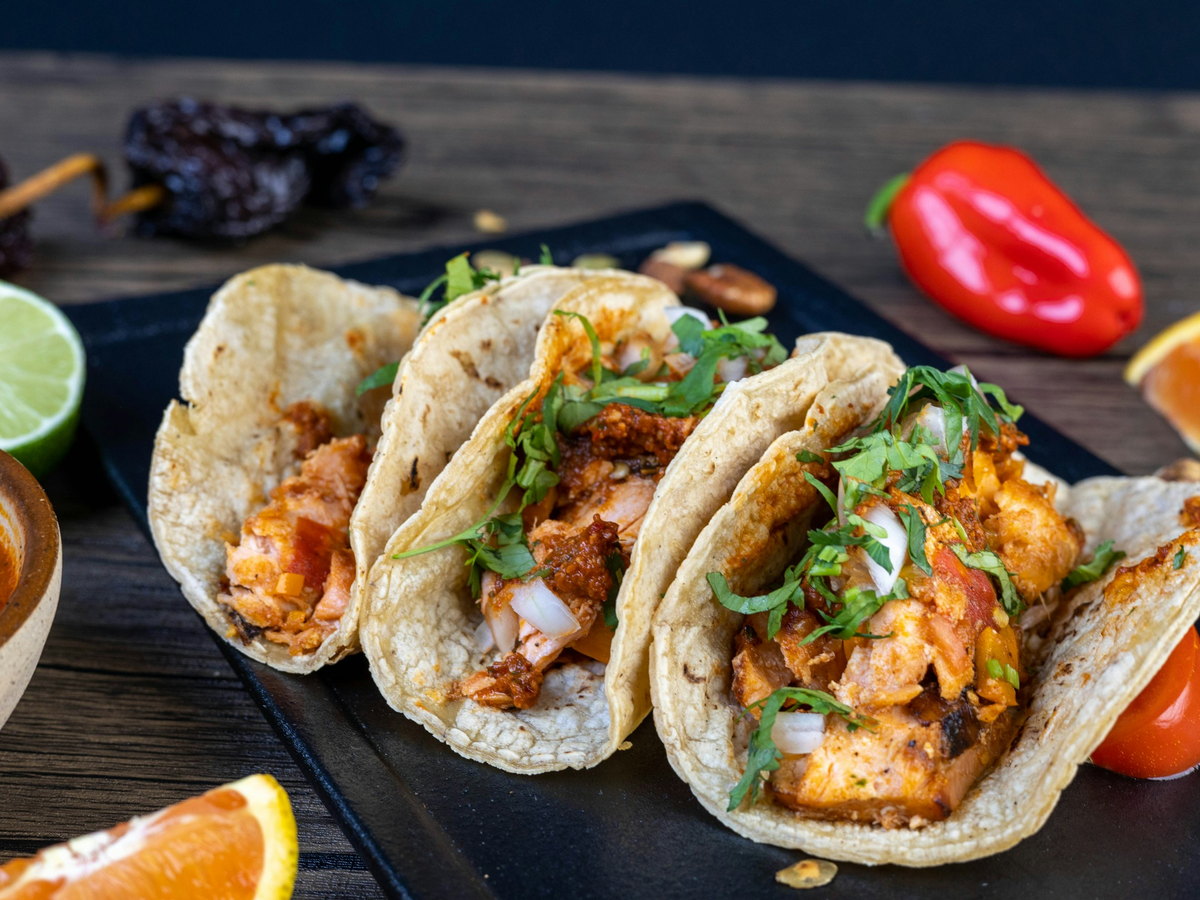
Salmon rubbed with chipotle and orange, roasted hard, and taken out of the oven while the middle is still translucent. It finishes on the tray in the time it takes to warm the tortillas.
- 20 minprep
- 4servings
you want dinner in half an hour and you would rather put five bowls on the table than plate anything
you are after the battered, deep-fried version — this is roasted, and it is not pretending to be the same dish
The whole thing is over in half an hour and most of that is the marinade sitting. Give it twenty minutes rather than two hours, because the lime and the orange start curing the outside of the fish and it turns chalky. Get the oven properly hot before the tray goes anywhere near it. Warm the tortillas while the salmon rests, put the onion and the coriander on the table in a bowl, and let everyone build their own — which is the only way they arrive hot.
What you buy
- 600 g salmon fillet, skin on, in two or three pieces
- 12 small corn tortillas
- 2 chipotles in adobo, chopped, plus 1 tbsp of the sauce from the tin
- 1 orange, juiced
- 3 limes, one juiced and two cut into wedges
- 1 small white onion, chopped as finely as you can manage
- 1 large handful of coriander, chopped, stalks and all
- 150 g red salsa, to serve
- 2 garlic cloves, crushed
- 3 tbsp olive oil
- 1 tsp ground cumin
- 1 tsp dried oregano
- 1 tsp salt
- 0.5 tsp black pepper
Take the salmon out before it looks done. A fillet that is opaque all the way through while it is still on the tray is already past it by the time it reaches a tortilla, because it holds enough heat to go on cooking for several minutes after the oven door opens — and the resting, the flaking and the warming of the tortillas all happen inside that window. The difference between fish that breaks into heavy wet flakes and fish that shreds into dry threads is about ninety seconds, and every one of those seconds is spent outside the oven. Pull it while the thickest part is still darker in the middle and let the tray finish the job.
What you do
- Mix the chipotles and their adobo sauce with the orange juice, the juice of one lime, the garlic, the cumin, the oregano, 2 tbsp of the oil and half the salt. It should be a loose paste rather than a liquid.
- Sit the salmon in it flesh-side down and leave it for twenty minutes at room temperature. Not longer: the citrus works on the surface of the fish the whole time, and an hour in gives you a chalky, half-cured outside that no amount of oven heat will fix.
- Heat the oven to 220°C fan and line a tray. Lift the salmon out and let the excess marinade run off it — what stays clinging to the fish is enough, and what pools on the tray burns.
- Lay the pieces skin-side down on the tray, rub them with the last of the oil, and roast for eight to ten minutes for a thick fillet. Take them out while the thickest part still looks darker and slightly translucent in the middle. Leave them on the tray.
- While the salmon sits, warm the tortillas one at a time in a dry pan over a high heat, fifteen seconds a side, and stack them in a folded tea towel as they come off. They stay soft in there for as long as it takes to eat them.
- Mix the onion and the coriander in a bowl with the juice of the second lime, the pepper and the rest of the salt. Ten minutes in the lime takes the raw edge off the onion.
- Flake the salmon into big pieces with two forks, straight off the skin — the skin is meant to stay stuck to the tray, and it will.
- Build them at the table: tortilla, a spoonful of salmon, the onion and coriander, a little salsa, a wedge of lime squeezed over at the last second. Three each is dinner.
Three things that decide it
- The salmon leaves the oven underdone, and that is arithmetic rather than caution. A thick fillet coming out at 220°C carries a great deal of stored heat, and that heat goes on moving inwards for minutes after the tray is on the counter. Fish gives almost no warning while it happens: the proteins in salmon set across a narrow range, and the same fillet goes from translucent to opaque to squeezing white albumin out of its seams in about the time it takes to warm six tortillas. Chicken forgives an extra three minutes and salmon does not. So the tray comes out early on purpose and the carryover is treated as a step in the recipe rather than an accident — which also means the resting is not padding. It is when the middle of the fish cooks.
- The marinade is short, and the acid is the reason. Orange and lime juice do not soak flavour into a fillet the way people assume; they work on the surface, and what they do there is denature it. That is the whole mechanism of ceviche, and it does not stop being true because the fish is going into an oven afterwards. Twenty minutes seasons the outside and colours it. Two hours gives you a band of opaque, chalky flesh a few millimetres deep that then cooks to something closer to tinned. The chipotles are what make the short soak enough: they arrive already smoked, salted and sitting in vinegar, so the marinade has nothing left to develop and needs no time in which to do it.
- Nothing warm goes on top, and nothing is sauced before it reaches the table. The raw onion, the coriander, the cold salsa and the lime are not garnish — they are the other half of the dish, and their job is contrast against hot smoky fish. Spoon the salsa over the salmon while it is still on the tray and all of it is lost at once: the fish steams under the sauce, the onion wilts in the residual heat, and everything arrives at one temperature tasting broadly of chipotle. It is also why the tortillas are warmed last and the tacos are built by the person eating them. A taco assembled five minutes early is a wet taco.
If you have not got it
- Salmon
- A firm white fish — cod loin, haddock or pollock, same weight and cut thick. It cooks a couple of minutes faster, flakes into smaller pieces and takes less colour from the marinade, so expect it to look paler than it tastes. Avoid the thin, delicate fish: sea bass, plaice and sole collapse between the tray and the tortilla, and there is no way to flake something that has already fallen apart.
- Chipotles in adobo
- 2 tsp chipotle powder, 1 tbsp tomato purée and a splash of red wine vinegar, which rebuilds roughly what the tin was doing. Smoked paprika is not a substitute for it, whatever the colour suggests — it brings the smoke and none of the heat, and the dish ends up tasting like a marinade for something else. If smoked paprika is all there is, add a fresh chilli with the garlic.
- Corn tortillas
- Small flour tortillas, which are more forgiving, fold without argument and need less heat. They also taste of considerably less and they soften rather than char, so the fish has to carry more of the dish. Whichever you use, buy the small ones: a large tortilla turns three tacos into two wraps, and the ratio of fish to bread goes with it.
- The orange
- Another lime and a good pinch of sugar. The orange is in there for sweetness against the smoke rather than for citrus — chipotle in adobo is sharp on its own, and without something sweet the marinade tastes thin. Pineapple juice does the same job and rather more of it.
Ahead, and afterwards
Fish is the worst thing on this site to cook in advance, and it is worth saying so plainly rather than offering a workaround that does not work. What can be done ahead is everything except the salmon. The marinade keeps three days in a jar in the fridge and is better for a day's sitting. The onion and coriander can be chopped the day before, though hold the lime back until an hour before eating or the onion goes soft and grey. Cooked, the salmon keeps two days covered in the fridge and should be eaten cold: flake it into a lunch with the leftover salsa and a squeeze of lime, or into a sandwich. Do not reheat it — there is no gentle way to warm a fillet that was deliberately pulled underdone, and a microwave takes it straight to dry. Raw salmon freezes and cooked salmon is not improved by it; the tortillas freeze well in their pack, which is the part most likely to be left over anyway.
If it went wrong
- The fish was dry and shredded into threads
- It was in the oven too long, almost certainly by less than you think. Salmon goes on cooking hard on a hot tray, so a fillet that looked exactly right when the door opened was several minutes past done by the time it was flaked. Set a timer for eight minutes, look at it then, and take it out while the middle of the thickest part is still darker than the rest. If white albumin has squeezed out along the top, that is the visible form of the same mistake.
- The marinade caught on the tray and turned bitter
- Too much of it went into the oven. Orange juice carries a fair amount of sugar and adobo carries more, and whatever pools on the tray is burnt long before the fish is cooked — after which the whole dish smells of it. Lift each piece out of the bowl and let it drip for a moment before it goes down; what clings to the fillet is all it needs. Lining the tray also means the burnt part leaves with the paper rather than seasoning the next thing you roast.
- It all tasted the same, just smoky
- The cold half was skipped, or it was added too early. The raw onion, the coriander and the lime at the table are structural rather than decorative, and they only work against fish that is still hot. If the tacos were built in the kitchen and carried through, everything equalised on the way. Put the bowls on the table and assemble there, and squeeze the lime once the taco is already in your hand.
Three ways to change it
Leave the salmon in one piece, sit it skin-side down on a doubled sheet of foil, and cook it over medium coals with the lid down for ten to twelve minutes. Do not turn it. The skin welds itself to the foil, the smoke does what the chipotle is only imitating, and the flaking works exactly as it does off the tray.
The closest weeknight version of the fried original without a pan of oil. Cut cod or haddock into thick fingers, toss them in seasoned flour with a teaspoon of chipotle powder, and fry in 3 mm of hot oil for two to three minutes a side. Drain them standing on their edge rather than lying flat, so the crust underneath stays crisp.
Replace the raw onion with 200 g of white cabbage shredded as thin as you can, salted, and left ten minutes with the juice of a lime before it is squeezed out. This is the Baja arrangement, and it makes a fuller and slightly cooler taco. It also keeps two days, which the onion does not.
Questions people ask
Can I use frozen salmon?
Yes, and most salmon has been frozen at some point regardless. Thaw it fully in the fridge overnight rather than in water, then pat it dry properly on both sides before it goes anywhere near the marinade — a wet fillet sheds the paste in the oven and steams instead of roasting. Do not marinate it while it is still part-frozen: the outside sits in acid for the whole thaw while the middle does nothing.
How do I know it is done without cutting into it?
Press the thickest part with the back of a spoon. It should just begin to open along its natural lines under light pressure and no further; if the flakes separate easily and completely, it is already past where you want it. A skewer pushed through the middle and held against your lip should come out warm rather than hot. And when it is genuinely a toss-up, take it out — a minute early is recoverable on the tray and a minute late is not recoverable at all.
Are these the fish tacos you get in a restaurant?
Not the Baja ones, no. Those are white fish in beer batter, deep-fried to order, with cabbage and a crema, and they are very good and very much a project: a pan of hot oil, a batter that has to be used the moment it is mixed, and a window of about four minutes in which they are worth eating. This is the roasted version, built to be cooked on a Tuesday and decided on in advance. It is a different dish rather than a shortcut to that one.
Cooking it for a different number
Written for 4. For two, halve the 600 g salmon fillet and leave the seasonings as they are — they scale badly by arithmetic and well by taste. For six or more, add half again rather than double, and use two trays or two pans instead of crowding one.
Or change the number once and let the shopping list follow. That is the one bit of this a person should never do by hand.
Read next
Sheet-Pan Chicken Thighs with Potatoes and Peppers
Skin that crackles, potatoes that catch at the edges, and one tray to wash. 35 min
Turkey Chili with Black Beans
Smoky, thick enough to stand a spoon in, and better on the second day. 15 min