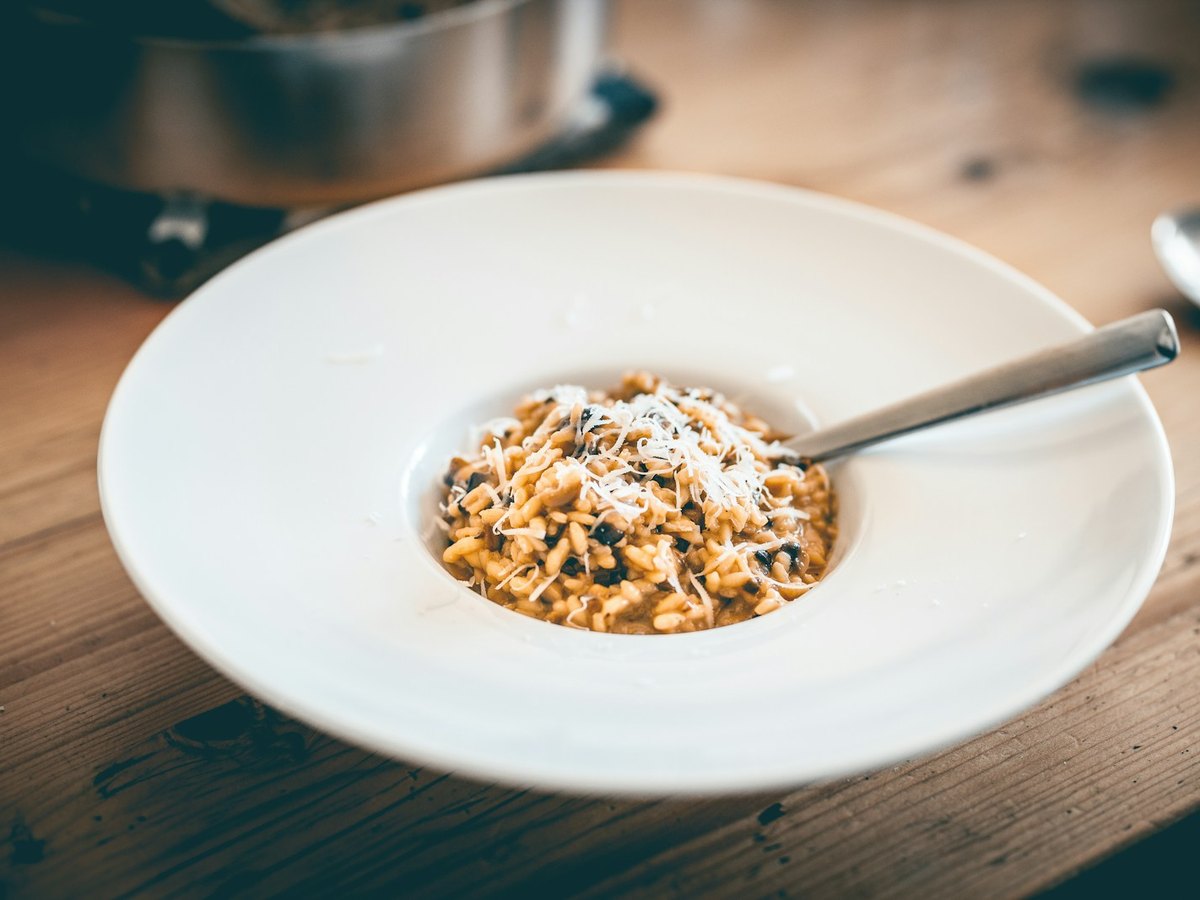
Mushroom Risotto, and the Mushrooms Cook Separately
The mushrooms are browned hard in their own pan and stirred in at the end. Cooked along with the rice they give up their water into it, and the risotto turns grey, loose and faintly of nothing.
- 15 minprep
- 4servings
you want something genuinely good out of cheap ingredients and you can give the hob twenty uninterrupted minutes
dinner has to cook while you do three other things — this is the one dish here that cannot be left, and it is worse reheated than almost anything else on the site
It wants about twenty minutes of your attention at the hob and there is no way around that. The stirring is not constant, though, whatever you have read — once every thirty seconds is plenty, and the gaps are when you grate the cheese and cube the butter. Keep the stock at a bare simmer in a pan beside you. Take it off the heat while it still looks slightly too loose, because it carries on thickening in the two minutes before it reaches the table.
What you buy
- 320 g carnaroli or arborio rice
- 400 g chestnut mushrooms, thickly sliced
- 1.2 litres chicken or vegetable stock
- 1 onion, chopped as finely as you can manage
- 150 ml dry white wine
- 80 g cold butter, cut into cubes
- 60 g Parmesan, finely grated, and more for the table
- 2 garlic cloves, sliced thin
- a small handful of flat-leaf parsley, chopped
- 3 tbsp olive oil
- 1 tsp salt
- 0.5 tsp black pepper
Do not cook the mushrooms in with the rice. It is the shortcut most recipes take and it costs the dish its colour and most of its flavour: mushrooms are largely water, and that water has nowhere to go except into the rice, where it dilutes the stock, drops the temperature of the pan and turns the whole thing a uniform beige. Browned separately in a hot dry pan, the same mushrooms lose that water to the air instead and come back concentrated. They go in at the end, when there is nothing left to spoil.
What you do
- Put the stock in a saucepan and bring it to a bare simmer. Leave it there, on the lowest heat, for the whole of the rest of the recipe.
- Heat 2 tbsp of the oil in a wide frying pan over a high heat and add the mushrooms in one layer, in two batches if they do not all fit. Leave them still for two minutes before touching them. Cook for six to eight minutes in all, until they have shrunk, browned at the edges and stopped releasing liquid. Salt them at the end, add the garlic for the last minute, and tip the lot into a bowl.
- Turn the heat down to medium, add the last of the oil and a knob of the butter to the same pan, and cook the onion gently for eight minutes with a pinch of salt. It should go soft and translucent without taking any colour.
- Add the rice and stir it for two minutes, until the grains are hot to the touch and their edges have gone glassy while the centres stay chalk-white. This is the step people skip, and it is what stops the rice collapsing later.
- Pour in the wine and let it bubble until the pan is almost dry and you can no longer smell alcohol — a minute or two.
- Add the hot stock a ladleful at a time, enough to just cover the rice, and stir every thirty seconds or so. When the pan is nearly dry again, add the next ladle. Keep going for about eighteen minutes, and start tasting a grain at sixteen. It is done when the centre has no chalk left in it but still gives a little resistance.
- Take the pan off the heat entirely. Beat in the cold butter and the Parmesan, hard, until the risotto looks glossy, then put a lid on it and leave it alone for two minutes.
- Stir the mushrooms and the parsley through, add the pepper, and loosen it with a last splash of stock until it spreads slowly when you tilt the plate. Serve it straight away, with more cheese on the table.
Three things that decide it
- The mushrooms are browned apart, in a pan that is too hot and not too full. A mushroom is mostly water, and browning is what happens only once that water has left. Put them in with the rice and the water leaves anyway, but it leaves into the risotto: the pan cools, the stock is diluted, and the mushrooms poach in the middle of everything instead of colouring. The result is not subtle — a grey pan of rice that tastes broadly savoury and of nothing in particular. Cooked hard and dry in their own pan and stirred in at the end, the same mushrooms keep both their colour and their shape.
- The stock has to be hot, and it goes in a ladle at a time. Both halves matter. Cold stock stalls the pan at every addition, and rice that keeps stopping and restarting cooks unevenly — chalk in the middle, mush at the edges. Adding it gradually is what keeps the grains rubbing against each other in a small amount of liquid, and that friction is the whole mechanism: it scrubs starch off the outside of the rice, and that starch is the creaminess. There is no cream in this dish and there should not be. Since the stirring is there for friction rather than for its own sake, it does not need to be constant — every thirty seconds does it, and beating the pan for eighteen minutes only breaks the grains up.
- The butter and cheese go in off the heat, and the risotto leaves the pan looser than you want it. Italians call the last step the mantecatura, and it is an emulsion: cold butter beaten into a pan that is hot but no longer cooking. If the pan is still on the flame the fat splits out and sits on top in a slick. Risotto also goes on absorbing liquid after you stop cooking it, so what looks right in the pan is stiff by the time it is eaten. It should be loose enough to spread by itself when the plate is tilted — all'onda, in a wave. Two minutes under a lid, then a splash of stock to bring it back.
If you have not got it
- Carnaroli or arborio rice
- Vialone nano, same weight, which cooks a couple of minutes faster and finishes a little looser. What will not work is long-grain, basmati or easy-cook rice: they carry far less of the soft surface starch the dish is made of, and no amount of stirring will produce it. That is a different dish, not a substitution.
- Chestnut mushrooms
- White button mushrooms, same weight — milder, and worth adding 15 g of dried porcini soaked in a little of the stock to make up for it. Wild mushrooms are better than either and want a shorter, hotter pan. Whatever you use, wipe them rather than washing them: a soaked mushroom has taken on the water you are about to spend eight minutes driving off.
- Dry white wine
- An extra ladle of stock and a squeeze of lemon at the very end. The wine is there for acidity rather than for the alcohol, and without something sharp the dish tastes flat in a way that is hard to place. Dry vermouth works well, and half the quantity is enough.
- Parmesan
- Grana Padano, same weight and a little milder, or half Parmesan and half Pecorino for something sharper. Taste before adding any salt if you use Pecorino — it is considerably saltier, and the stock has already seasoned the rice.
Ahead, and afterwards
Risotto is not a make-ahead dish, and it is worth being blunt about that: reheated, it is a fair bit worse than it was. Two things do work. The mushrooms can be browned up to two days early and kept in the fridge, which is the messy, smoky half of the job done. And the base can be part-cooked the way restaurants do it: stop at about twelve minutes, spread it thin on a tray so it cools fast, refrigerate for up to two days, then finish with the last of the hot stock, the butter and the cheese in six or seven minutes. Cooked through, it keeps three days in the fridge but sets solid. Loosen it in a pan with a splash of stock over a low heat, never in a microwave, which takes the outside well past done before the middle has warmed. Freezing is not worth it — the grains turn grainy and the emulsion never comes back. Leftovers are better used as something else: press them into flat cakes and fry them in butter until crisp on both sides, which is the best thing that happens to day-old risotto.
If it went wrong
- It came out grey and watery
- The mushrooms were cooked in with the rice, almost every time. Their water diluted the stock and cooled the pan, and nothing in the dish ever browned. Brown them separately, hard, in a pan hotter than feels sensible, and stir them in at the end. The second cause is stock added cold, which does the same thing to the temperature at every ladle.
- The rice is chalky in the middle but the pan is dry
- The heat was too high, so the liquid boiled off faster than the grains could take it in. Turn it down until the surface is barely moving and keep adding stock — eighteen minutes is a guide, not a rule, and rice takes what it takes. If you have run out of stock, hot water will finish it without much harm.
- It was stodgy by the time it reached the table
- It carried on absorbing after it left the heat, which it always does. Take the pan off while the risotto still looks slightly too loose to serve, and if it has already tightened, beat in a ladle of hot stock to bring it back. Cooking it a couple of minutes past done produces the same result and cannot be undone.
Three ways to change it
30 g of dried porcini soaked in 300 ml of hot water for twenty minutes. Lift them out, chop them, and use the soaking liquid as part of the stock — poured carefully, leaving the last centimetre of grit behind in the bowl. Much stronger and much cheaper, and it needs no separate browning pan, because there is no water left in them to drive off.
Toast the rice, add all the hot stock at once, then cover and bake at 180°C fan for eighteen minutes before beating in the butter and cheese. You lose the loose, waved texture the gradual method builds and gain the ability to cook it without standing there. A reasonable trade on a weeknight; not the version to cook the first time.
Same weight of pearl barley and roughly double the time — about forty minutes, with more stock. It never goes as creamy, and it is not trying to: the grains stay separate and chewy, and it is far more forgiving of being left a few minutes too long. The better choice for anyone who has overcooked three risottos in a row.
Questions people ask
Do I really have to stir it constantly?
No, and the belief that you do is most of why risotto has a reputation for being difficult. What the stirring does is rub the grains together so they shed the starch that makes the dish creamy, and a stir every thirty seconds achieves that. Beating it continuously for eighteen minutes breaks the grains up and gives you something closer to porridge. What you cannot do is walk away for five minutes.
Can I use ordinary long-grain rice?
Not for this. The creaminess comes from a soft surface starch that carnaroli, arborio and vialone nano carry a great deal of and long-grain varieties largely do not. Basmati stirred in stock for twenty minutes gives you wet, broken basmati. If risotto rice is not available, pearl barley is a better substitute than the wrong rice, though it makes a different and chewier dish.
Is risotto rice the same as paella rice?
Both are short-grain, and they are not interchangeable. Bomba and calasparra absorb around three times their volume in liquid and are cooked untouched, because paella is meant to stay separate and to crust on the base of the pan. Risotto rice is stirred precisely so that it does not stay separate. Using one for the other gives you a version of the dish cooked against its own intention.
Cooking it for a different number
Written for 4. For two, halve the 320 g carnaroli or arborio rice and leave the seasonings as they are — they scale badly by arithmetic and well by taste. For six or more, add half again rather than double, and use two trays or two pans instead of crowding one.
Or change the number once and let the shopping list follow. That is the one bit of this a person should never do by hand.
Read next
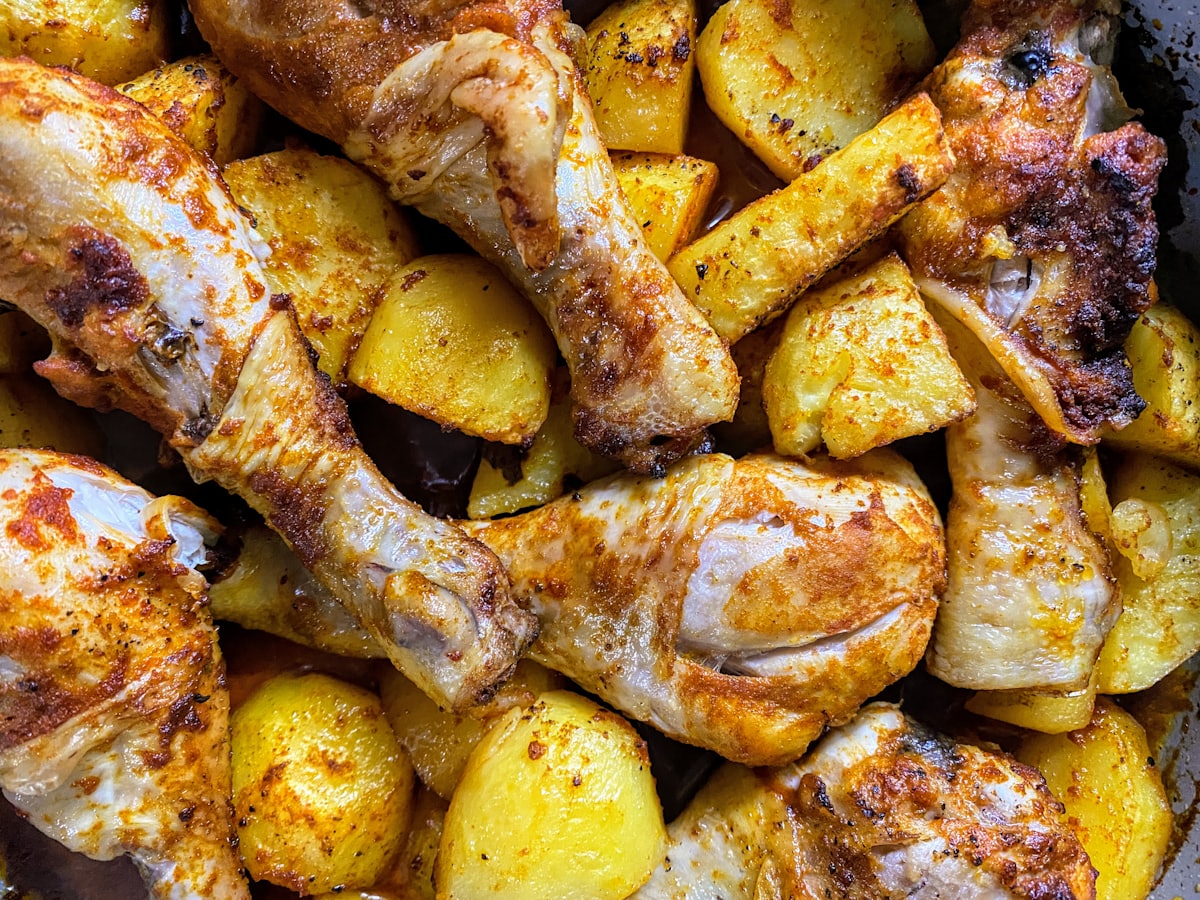
Sheet-Pan Chicken Thighs with Potatoes and Peppers
Skin that crackles, potatoes that catch at the edges, and one tray to wash. 35 min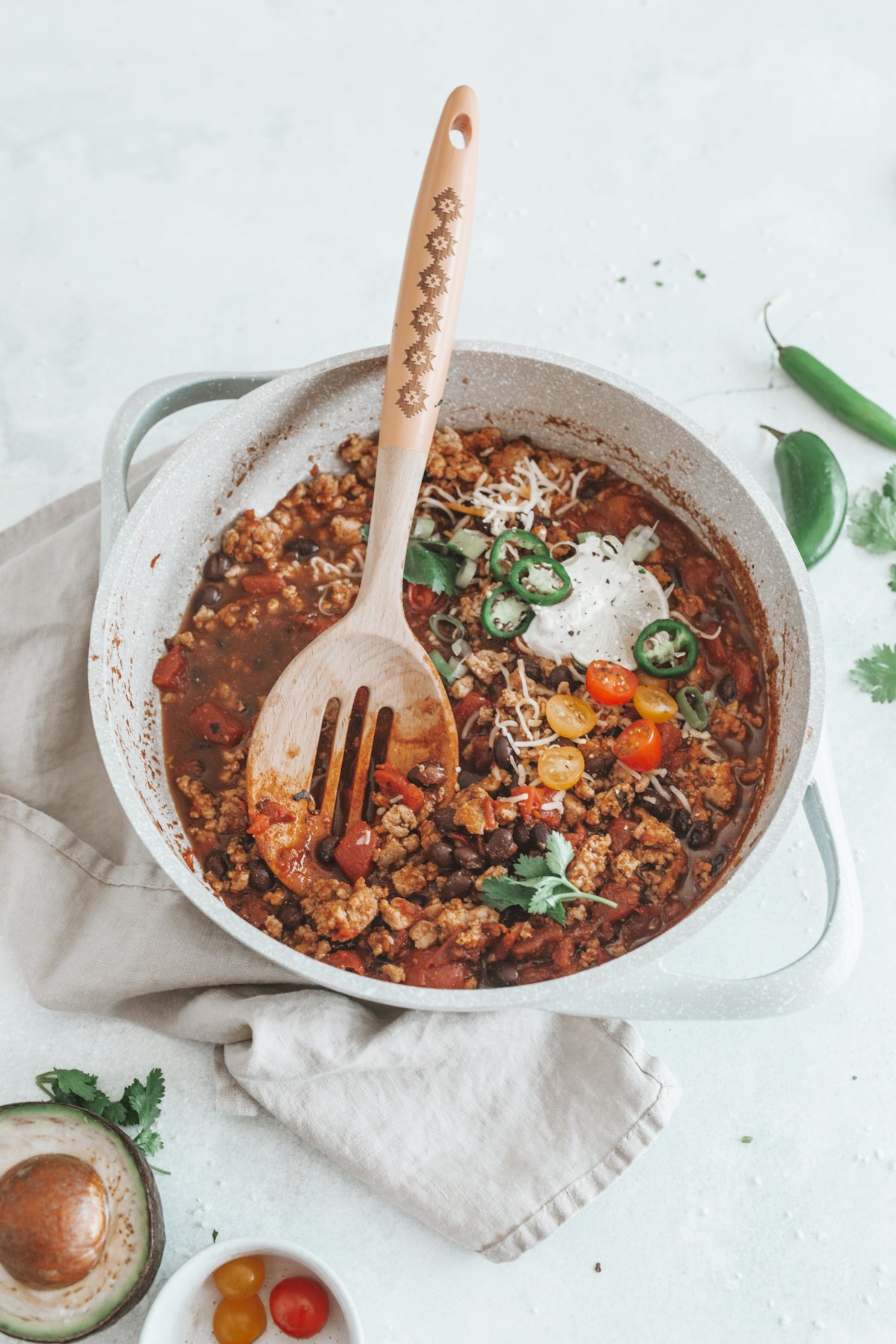
Turkey Chili with Black Beans
Smoky, thick enough to stand a spoon in, and better on the second day. 15 min